Monday, 19 December 2011

Interview with Deborah Bull, Former Ballerina and ROH Creative Director

Guest Blog post by Vera Litvin

Image courtesy of the Royal Opera House

Deborah Bull was going to be a ballet dancer “since before she could remember”. Note “was going to be” rather than “wanted” – a reflection of her focus, ambition and determination.

She started out with the Royal Ballet 30 years ago and worked her way up to become principal ballerina. In 2001 she retired from dancing and took an executive position at the Royal Opera House, culminating with her current role as Creative Director. In addition to this, she is a successful writer and broadcaster, with several popular BBC television and radio series under her belt. She is at the LJCC today to promote her fourth book “The Everyday Dancer.”  When I mention this stellar career to her she modestly admits that it’s been “busy.”

For Deborah, dance at its best is “a way of telling stories, exploring emotions, states of mind and relationships between people.” She argues that it is relevant to everyone because these are issues we deal with in our own lives all the time. Deborah Bull grows particularly animated when she describes how dance is central to, well, being human:”It is how we praised our Gods, tried to tame the elements, seduced one another, mourned people, marked the transition from childhood to adulthood. Dance had been central to so many cultures for so long…” When Deborah talks about dance, you can certainly see that passion and the eloquence for which she is famous.   

A vicar’s daughter, Deborah Bull has a strong work ethic. Her favourite word is “rigour”, while her least favourite is “chillax”. She insists that dance is not a “punishing” profession, just “hard work”. “There is a difference” she stresses, explaining that hard work is needed to get the dancer’s body to the necessary level of fitness. Once this level is reached, however, dancing does not mean constant pain, as I had previously supposed. The upside is “a sense of achievement, of using yourself totally and of being able to follow through a childhood dream.”

Her time at the ROH, which is coming to a close soon, has been all about “New art, new artists and new audiences”. She has fought hard to create a “low risk” space in which new choreographers can try out their work. Deborah Bull insists that ballet should never be “safe” and should always be pushing new boundaries. Asked where she sees ballet moving in the future, she answers that people want to be more involved in the performance: “The notion of the sit-on-your-hands spectator is really changing” she says.

Hearing Deborah Bull speak, you are certainly excited to see what will be happening in the world of dance and the arts next. She sees much more “blurring of the boundaries between art forms” in the future.  Her new position as Cultural Partners Director at King’s College London, starting in March 2012, will see her working across all art forms. There is no doubt that her focus and determination will be channeled into creating new “ways of telling stories”. I for one can’t wait to see what this dynamo will do next…

Don’t miss fantastic authors like Deborah Bull at the next Hampstead and Highgate Literary Festival: Sunday 9th - Tuesday 11th September.  


Wednesday, 14 December 2011

Building Work Commences On New Youth Centre in Golders Green

 Guest Blog post by Vera Litvin
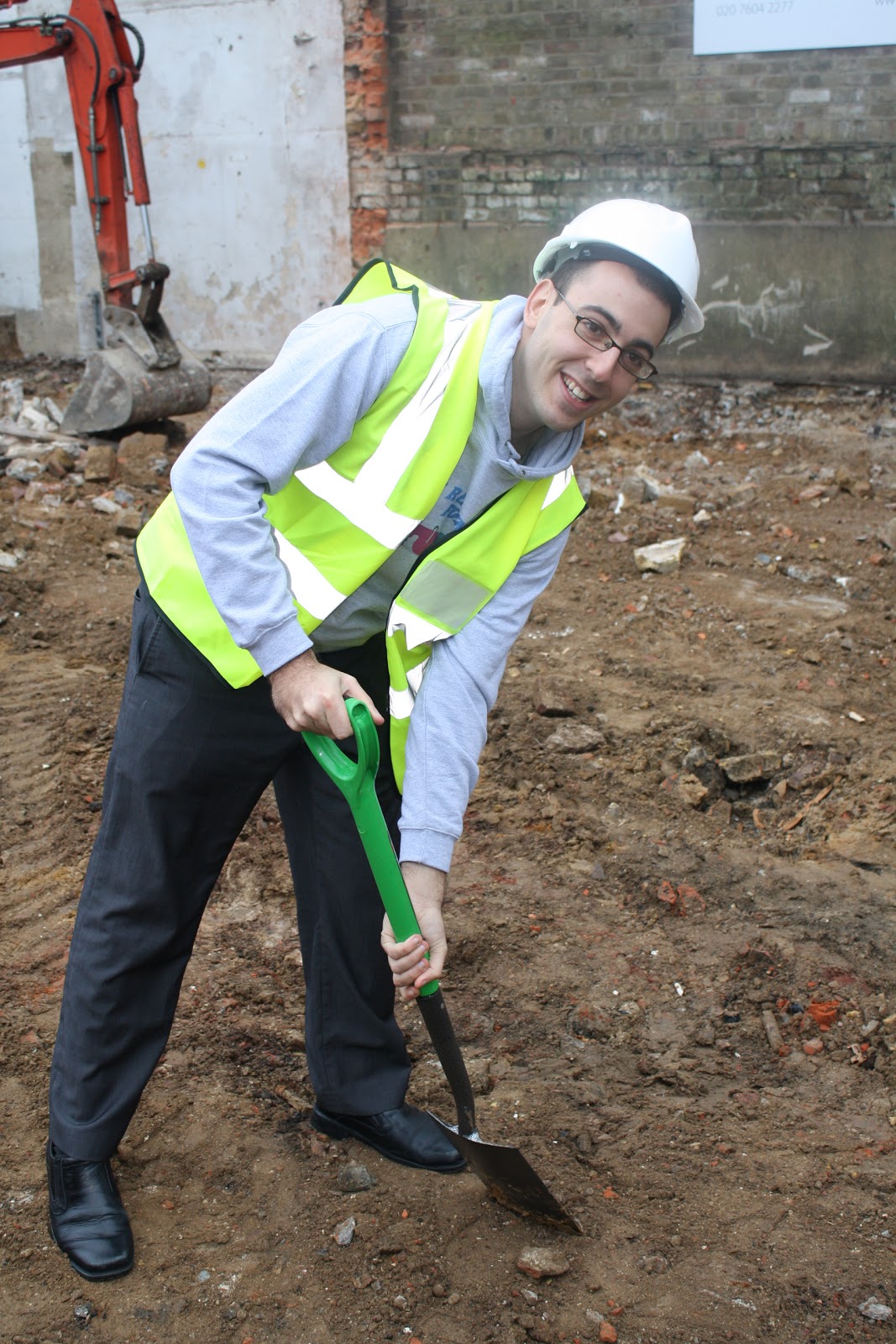
Youth Manager Laurence Field at Groundbreaking

Last Thursday, on a cold and blustery day, something special was happening at the LJCC. Our patrons, board members, volunteers and staff, as well as charity heads, journalists and the MP for Finchley and Golders Green, Mike Freer, all gathered for the groundbreaking ceremony of the Catherine Lewis Youth Centre.

This 2,500 sq.ft. Youth Wing will be built on the LJCC’s existing site at Golders Green and will house the activities of the Fusion youth programme. Fusion includes activities such as filmmaking, cartooning and cookery for 8-17 year olds and has been steadily outgrowing the capacity of the main building.

Speaking to LJCC Youth Manager Laurence Field about the significance of the Youth Wing, he explained that research has shown that there is a demand in the community for a secure youth space which is unaffiliated. The aim of the Youth Wing is to allow children to enjoy creative skill based activities without promoting any particular one kind of “Jewishness” above others. He also mentioned the importance of having a space which young people could “call home” and have “ownership” of: from having a lounge room to relax in to a screening room in which to show the films they have created.

MP Mike Freer placed his support behind the project and spoke of the importance of instilling confidence in younger members of society through creative activities. LJCC Chairman Michael Marx thanked all the funders who are making the building possible, including, among others, the Catherine Lewis Foundation, the Jewish Youth Fund and Natie Kirsh.   

“We’ve been talking about it for so long, it’s exciting to finally see it happening!” commented LJCC trustee and Kindertransport survivor Joanna Millan as the first clod of earth was being ceremonially turned.

With the aim of having the Youth Wing built and running within a year, this is going to be a very interesting time for youth provision in north London!

To see the latest Fusion activities, click here.

Thursday, 17 November 2011

Under Hitler's Nose: Fugitive Jews in Wartime Berlin

Guest Blog post by Vera Litvin

A varied audience turned up to listen to historian Roger Moorhouse discuss “Fugitive Jews in Wartime Berlin” this Tuesday: from regulars to the centre to media students from Belfast. We were all united by one thing: with our comfortable lives in which food, accommodation and legal status are taken for granted it wasn’t easy for us to imagine life as a “non-person” in Nazi Berlin. However, Roger Moorhouse’s engaging and vivid lecturing style quickly drew us into the underground world of Jews who decided to destroy their papers, leave behind their identity and hide in Berlin from 1935 onwards in order to escape deportation to the camps. 

These Jews were known as the “taucher”, literally “divers”, who dove beneath the respectable surface of society and lived on its margins. There were 10-11 thousand “taucher”, of which 1400 survived the war. This means that roughly 1 out of 8 of Jews hiding in Berlin survived, quite a remarkable statistic considering the hardships they had to endure. Going underground was to commit yourself to a life of lying, cheating and stealing. As a “non-person” without documents you were not eligible for any food rations and always in danger of denunciation and being caught by the Gestapo.

Roger expanded on all aspects of the lives of these hidden Jews, from using peroxide to dye their hair an “Aryan” blonde, to the tough decision to become “illegal” in the first place when previously they had been law-abiding citizens. There are many stories of the kindness of German Berliners in helping “taucher”, ranging from those who provided a few nights’ shelter to those who provided documents, allowing Jews to assume new German identities.
Roger Moorhouse
Despite the mental strains, isolation and exhaustion that life an illegal Jew in Berlin must have carried, there are also positive moments in Roger Moorhouse’s account. “I thought our life was a great adventure…it was great fun” remembers one young illegal Jew. Some Jews, like Larry Orbach, who lied and cheated his way across Berlin and later wrote an uplifting memoir about it, found great freedom in a life lived outside the norms of a repressive society. Ultimately, this is a fascinating story of courage, audacity, inventiveness and sheer will to survive on the part of “taucher” and bravery and kindness on the part of those who helped them. 

Other events not to miss at the LJCC: Rex Bloomstein: The Director’s Cut – Confronting the Holocaust at 7.30pm on Thursday 24 November

Book Launch: Fleeing From the Fuhrer at 7.30pm on Monday 5 December

Survivors Speak: Freddie Knoller at 7.30pm on Thursday 8 December

Roger Moorhouse’s book Berlin at War is available here

Wednesday, 16 November 2011

How do we judge success?

The way we view ourselves is too often affected by how society views us.

Compare the man who lives in a big house, has a well paid job in the city, drives an expensive car, goes on exotic holidays and spends lots of money on leisure activities with another man of the same age, who lives in a two bed roomed flat on the fifth floor of a tower block. He catches the train to work, as he doesn’t have a car, hasn’t been on holiday for years and rarely goes out because he can’t afford it. Who would society initially regard as the most successful?

Sadly, many people judge success solely on what we possess and how much money we earn.  Lower income earners can be made to feel inferior. The very term High Net Worth Individual, suggests that society puts value on prosperity.

However, what of the man in the flat? Perhaps he is a dedicated youth worker, who spends his life helping troubled teenagers to turn their lives around, mentoring them and putting them on the right path. Despite low pay, he finds his job rewarding and fulfilling. He is happy. He has a loving wife and a child on the way. The man who lives in a big house, might work in the city as a bond dealer but find his job unfulfilling, has a failed marriage and is continually looking for satisfaction in the things he can afford to buy. Who should we now consider to be the most successful?

Of course these are extreme examples, tailored to make a point. I’m not suggesting that all bond dealers or wealthy people are unhappy and unfulfilled, nor indeed vice versa, but the point is why doesn’t society judge success on what we do and how we approach life, rather than what we own? And even more importantly, when will we judge our own success on what we do rather than what we own?

We all want to live comfortable lives without financial worries, but that should not mean that we have to sacrifice our personal fulfilment to achieve monetary success.

Saul Djanogly is an interesting case in this respect. He started his career working on the floor of the London Stock Exchange in 1982. He has since practised as a private client stockbroker and investment manager and now runs his own Wealth Management business with a special focus on Values Based Financial Planning. Unusually, he previously trained as a Rabbi and holds a degree in Jewish Studies from London University. So how does he balance his ethical training with commercial success apply these principles to his commercial life?

His answer is simple and does not just apply in business but in life generally. “I am not what I have, but what I give to others.  If I give value in business to my customers and colleagues, then I am successful. Equally, if I give value in business, the money will follow.’

Come and hear Saul Djanogly talk at the LJCC on Thursday December 1st on the Kabbala of Money.

Friday, 11 November 2011

Four Extraordinary War Heroes at the LJCC

Guest Blog post by Vera Litvin

Yesterday, one day before Remembrance Day, LJCC students had the honour of meeting four very special WWII veterans. They had come to the LJCC to participate in Dr Helen Fry’s “Churchill’s German Army” course. What is it that makes Willy Field, Bill Howard, Geoffrey Perry and Harry Rossney so extraordinary? What makes their story different from that of any other British soldier who fought the Germans? It is the fact that all four men were born in Germany and Austria and fled to Britain to seek refuge from Nazi persecution.

Willy, Bill, Geoffrey and Harry belonged to 10,000 German and Austrian refugees who chose to fight for Britain during the War. Their service was not at first encouraged, and was in fact actively prevented as most of the refugees were interred, and in Willy Field’s case, even deported to Australia in hideous conditions on the infamous “Dunera” vessel. Despite this, there was a burning feeling among these men that this was their War. “The People we were fighting were out to eradicate me” says Bill Howard. “The very simple fact was that the Nazis had to be defeated” adds Harry Rossney, “Coming to England saved my life. I wanted to say thank you”. At first, the only way of showing their commitment to a country in which they were still considered “friendly enemy aliens” was to volunteer for the non-combatant Pioneer Corps.

It was only later on in the War that these men were allowed to enter fighting units. They did this and many saw active service, like Willy Field who fought for 11 months on the frontline and participated in the D-day landing, or Bill Howard who used his German language skills to do top secret work for the Royal Navy. Geoffrey Perry had the distinction of being the man to shoot and arrest the traitor and Nazi propagandist William Joyce, known as Lord Haw Haw, while Harry Rossney carried out the vital work of hand writing signs for the temporary crosses on the graves of fallen soldiers.

Historian Helen Fry says that the impact of these men and others like them is not to be underestimated: “Without their contribution the War would not have been shortened. It’s marvellous that the story is finally coming out”. Our listeners felt the same way, many of them explaining that their fathers too had been in the Pioneer Corps and how grateful they were for this opportunity to find out more about what happened to them. There was a real sense at the event of being able to “touch history” and to honour four extraordinary men.  

Image: L-R Geoffrey Perry, Harry Rossney, Willy Field, Dr Helen Fry, Bill Howard

To hear more exciting and unusual stories from members of “Churchill’s German Army” join Dr Helen Fry and her guests on Thursday 17 and Thursday 24 November at 2.00pm. http://www.ljcc.org.uk/courses/1821-churchill-s-german-army-hope-and-courage.html

Wednesday, 19 October 2011

Blackberry teenagers

This week, my seventeen year old son’s Blackberry broke. No big deal, we’ll get it fixed I thought, but how wrong was I? After 24 hours he’s been pacing around nervously, looking at the messages he can see are coming through, unable to read them or know who they’re from, and when I told him we would have to send it away to be fixed, his reaction, in my opinion was completely out of proportion with the actual situation.  Taking a Blackberry away these days from a teenager is like putting him in solitary confinement.

Now if you’d said to me two years ago that he would even have a Blackberry, I would have laughed at you, but now, they seem to be the most popular way of teenagers communicating with each other. Forget talking on the phone they are constantly “BBMing” each other (for those of you not in the know that’s Blackberry Messaging) and I have no idea what they are talking about. How can they have anything to say to each other at 8am before school, or on the way home from an evening out, when they’ve just spent four hours together? But they do, and whatever it is, is far more important than anything I might have to say to them.

When I stopped to analyse what annoys me in particular about this, I wondered if maybe it is because when I was younger, I was brought up to believe that whispering in someone else’s company is rude, and in a way, that is what they are doing. You know they’re communicating with someone, but you don’t know what they’re saying and you’re not included in the conversation, so it ends up irritating me and I also begin to wonder, as a parent, what is so secretive?

And what about Facebook, Skype, Myspace, Twitter and all the other online sites in which teens participate constantly, it is becoming increasingly difficult for them to switch off and just be themselves, on their own. Their friends are ever present, as are those they don’t necessarily want intruding in their lives.

As parents should we be accepting this new wave of technology as just the new way, and how our children will view the world? In some respects it is a wonderful thing that my son is able to chat with his friend he knew from primary school as he gets his breakfast in England and his friend waits for his teacher to arrive in the class in Spain. Staying in touch with friends from around the world, or even from our past was much harder work when I was younger but to what extent is this new way of communicating, detracting from their face to face social skills and increasingly intruding in family life? What parent of teenagers can honestly say they don’t find it tempting to BBM them in their rooms from downstairs, as it is the most effective way of getting their attention?!

Join us for an interactive evening for mothers and fathers, discussing parenting teenagers of the technology generation.

Tuesday, 27 September 2011

Sushi, Gefilte fish and being Jewish in Japan

On October 16th the LJCC will be holding a Family Sushi making workshop, giving the opportunity for families with young teenagers to learn a new skill together. “So what’s Jewish about that?” I hear you ask. “Since when did Sushi become a part of Jewish Culture?” And yet, if you type Kosher Sushi in to Google, your search returns 9,870,000 results.

One such result suggests that perhaps we should consider the possibility that Gefilte fish is a Jewish version of sushi, or maybe even the predecessor of it? After all, Gefilte fish, although cooked, does have the texture of raw fish, is boneless and shaped into a ball, and decorated with carrot.

Or maybe it’s just that in this shrinking world, cultures from across the globe are intermingling, as are its people and particularly as the Diaspora reaches the further flung corners, our culture embraces that of our adopted countries. After all gefilte fish, knishes and cholent all originated from Eastern Europe.

So what of the Jews in Japan? Jews have been living in Japan since at least the 1860s, perhaps much, much longer. The first settler we know of in modern times arrived in Yokohama in 1861, and synagogues were later established in Nagasaki (1889), Kobe (1937), and finally Tokyo (1953). Today there are approximately 2,000 Jews in living in Japan, excluding military personnel. Most reside in the Tokyo area with about 60 percent come from the U.S., 25 percent from Israel, and the rest from all over the world. There are also a handful of Japanese converts.

There are three active Jewish communities in Japan today, one in Kobe and the others in Tokyo including a reform synagogue and they are made up from local residents, business men, and travelers from around the world. One resident, when asked by the JC what it is like being Jewish in Japan replied "The answer depends on my mood. My negative response is that it is rather difficult (especially if you are kosher), since pork is the staple of the Japanese diet, and they also rather like their shellfish. But if I am feeling positive, the answer is that being Jewish in Japan is really not that different to being Jewish in any other place in the world. We have always been a nomadic people - where we go, our Jewish identity follows.”


And perhaps that is why, at the LJCC we see that making Sushi is not such an unusual thing for us to be doing, but we are just embracing the fact that there are Jews living all over the world, managing how they can and incorporating their host country’s culture in to their own.


If you are living in a small Jewish community around the world, or know of anyone we would love to hear your stories and to learn how you incorporate new cultures in to your Jewish customs.