Wednesday, 28 March 2012

The Secret Jewish World of Soho and Fitzrovia

Guest blog post by Vera Litvin

I had always thought that the East End was where Jews in London had historically lived. What I hadn’t realised was that a vibrant Jewish community had also thrived in the West End areas of Soho and Fitzrovia. This all changed when I accompanied tour guide Stephen Burstin and a group of 20 LJCC students on a walk to discover the Jewish past of these places.  

"View" by Holocaust Survivor Naomi Blake in Fitzroy Square Gardens

We began at Fitzroy Square – it had at various times been home to British authors George Bernard Shaw and Virginia Woolf, but it also has clear Jewish connections: the West Central Jewish Lads' Club was established here in 1898. It provided evening recreation for Jewish teenage boys who lived or worked in the district. The Fitzroy Square Garden also holds a statue by Naomi Blake, who survived Auschwitz as a child. 

The Montagu Centre

Our next stop was the Montagu Centre. Today, this is the home of Liberal Judaism in London, named after the Honourable Lily Montagu, C.B.E. In 1893 Lily Montagu , the daughter of a wealthy Jewish banker and MP, founded the West Central Jewish Girls' Club in Dean Street, Soho. It provided the young tailoresses who joined the club with more than fifty classes including physical training, art, drama and music. The club was a deliberate attempt to combat the effects of the seedy area in which the girls lived.

The popular Fitzroy Tavern run by Judah Kleinfeld

An activity I had never associated Jews with was pub-keeping, but it turns out that the most popular pub in the area – the Fitzroy Tavern was run by a Russian Jewish Refugee Judah Morris Kleinfeld. His daughter Annie worked behind the bar and did all the book-keeping as Judah could not write English. It was “pop” Kleinfeld’s larger than life personality which attracted writers, artists and composers to what became the foremost bohemian pub in the area. The pub was closed on Rosh Hashanah and Yom Kippur and was heavily involved in charity work with its innovative “pennies from heaven” scheme, in which people threw darts at the ceiling with little bags of money attached with them. The money was then collected and given to charity. Another famous pub with a Jewish publican was the Pillars of Hercules, run by Harris Rothstein to support his six daughters.   

The Pillars of Hercules run by Harris Rothstein. (Photo Credit: David Ruback)


Round a little alleyway, we discovered perhaps the most obvious sign that a Jewish community once flourished here: the Westminster Jews Free School building.

Building of the Westminster Jews Free School. (Photo Credit: David Ruback)

These are only some of the stories we uncovered:  among others were former synagogues with charismatic rabbis, handsome Jewish butchers, restaurants which attracted a clientele of stars and many more. Stephen Burstin showed us that Soho and Fitzrovia teem with signs of a Jewish past, if you only know where to look! He guided us expertly through all the stories and memories of the area, bringing them vividly to life.

For some members of our group the trip held the additional significance in that their families came from the area. Do you have a West End story or memory? We’d love to hear it. Please email it in to vera@ljcc.org.uk

Many thanks to participant David Ruback for permission to use his photographs and to Stephen Burstin for leading the walk

Stephen Burstin’s next walk for the LJCC will be to Spitalfields and Aldgate on Monday 23 April. Full info available here or by calling 020 8457 5000


Monday, 20 February 2012

Only 2 Sardines Were Harmed in the Making of this Blog

Guest blog by Julia Braun

On Friday the LJCC Marketing department (my colleague Mandy and I) had an outing to The Providores & Tapa Room on Marylebone High Street. This wasn’t just a social call but was all in the name of work – the fact that brunch was included was a very lovely bonus…more on that later.

The Providores is run by top New Zealand chef Peter Gordon and as well as another restaurant in London, one in Auckland, and a hectic international schedule, Peter has managed to find time to squeeze in judging our Pavlova recipe competition – part of the centenary celebrations we are having to commemorate 100 years since Anna Pavlova moved into our very own Ivy House.

So back to the food – apparently the Tapa Room, which is the all day restaurant, café and wine bar part of the restaurant (upstairs is a more formal dining room), is renowned for its brunches and regularly has people queuing round the block on a weekend. I can whole-heartedly recommend the grilled sardine & roasted tomato bruschetta, in fact my mouth is watering now just thinking about it.

Meanwhile I am very excited to say that entries for the competition are coming in thick and fast, and it is no wonder when the winning recipe, after being tried & tested by Peter Gordon, will go on the menu of The Providores for a month.

If you would like to enter, please send me your own personal “Pavlova-inspired” recipe and an optional photo of your dessert, by Sunday 15 April to julia@ljcc.org.uk. Please don’t forget to also include your name, address and phone number.

Finally, I must say many thanks to all those who offered to help me taste the recipes, however I am not one to shirk responsibilities and as challenging as it will be, I think I am ready for it!

You can find out more about the Pavlova 2012 programme of events here: http://www.ljcc.org.uk/events/genre/56-pavlova-2012.html

Tuesday, 7 February 2012

Vermeer’s “Jewish” Women?

Guest blog post by Vera Litvin

Over 300 years after his death, the Dutch painter Vermeer is still causing controversy, not least at the London Jewish Cultural Centre. BBC Art Critic Estelle Lovatt joined us to give us her take on Vermeer, exploring the Jewish element in his work. She argued that there was certainly a Jewish influence on Vermeer and that he would have been deliberately reaching out to a wealthy Jewish clientele with his paintings. He would have been aware of Rembrandt’s work which may have depicted patrons in the guise of ancient Israelites (a famous example is the “Jewish Bride” which seems to depict a couple of Rembrandt’s clients as Isaac and Rebecca).
The 'Jewish Bride' was painted by Rembrandt in 1667

However, Vermeer’s work does not deal with Jewishness in the same overt way. Instead, Lovatt argues, it gives us an image of the woman in the home, very much in keeping with the Jewish tradition of the “Eshet Chayil”.  As celebrated in the famous hymn of the same name, which is customarily recited on Friday evenings, the “Eshet Chayil” is a modest, God-fearing and capable woman. This description seems to fit many of Vermeer’s female portraits. Many of his subjects are modestly dressed, involved in some domestic occupation: be it a maid pouring milk, a lace-maker with her bobbins or a lady playing music. Their gaze is often modestly averted from us. The women are also frequently depicted in the home: in an enclosed, protected, feminine space.

Eshet Chayil? Was Vermeer producing work for a Jewish Audience? ('The Milkmaid' by Vermeer, circa 1658)

For Estelle Lovatt, Vermeer’s paintings of women for the most part provide “the feeling of a Friday night” even if none of the women are actually lighting Sabbath candles or are even Jewish. It is “the feeling of warmth, the feeling of peace, the feeling of making you welcome, the feeling of wanting to stay in that area with the woman.”  These images, she believes, would have appealed to Vermeer’s Jewish contemporaries.

Estelle Lovatt also touched on the work of modern Israeli artist Noa Lidor, who takes Vermeer as her starting point and goes on to create works of art that are radically different to his. Her sculptures, installations and drawings frequently use everyday, feminine objects such as thimbles, recorders and even bells to explore the role of the woman in the home.

Although some in the audience did not agree with Estelle’s analysis of Vermeer’s “Jewishness”,   I found it an eye-opening take. It also made me reconsider what we refer to as Jewish art. Is it, Estelle asks, art created by a Jew, or art depicting specifically Jewish topics, or can it perhaps simply be art which has a Jewish “feel” about it in some way? In this lecture, Estelle Lovatt certainly succeeded in challenging our preconceptions about an artist whom many of us feel we already know.


Wednesday, 25 January 2012

‘To Watch Prejudice and Stay Silent Cannot Be an Option’

Guest blog post by Lara Smallman

Expanding on the theme of this year’s Holocaust Memorial Day, ‘Speak up, Speak Out,’ Natasha O’Leary, a student from Ashmole Academy in Southgate shared her reflections on a recent visit to Auschwitz with an audience of 250 people at City Hall on Tuesday 24th January.

Ashmole Academy has participated in the Holocaust Educational Trust’s Lessons from Auschwitz Project, which invites sixth-form students and their teachers ‘to take part in two afternoon seminars and a one-day visit to the former Nazi extermination camp of Auschwitz-Birkenau in order to then pass on the lessons in their schools and communities.’

‘I am part of the last generation who will be able to hear about the Holocaust from those people who lived through it, and who can speak about it’. ‘It is my duty,’ Natasha went on to add, ‘to ensure that my generation, and future generations will remember the Holocaust, and understand its importance. We must speak out for those who don’t have a voice’. Naomi Lyne, a fellow student explained how the trip had ‘given [her] a totally different perspective than textbooks alone could ever give.’

Natasha and Naomi’s words followed the personal testimony (which you can watch in this video) of Holocaust survivor Anita-Lesker Wallfisch who lost her parents to the concentration camps and who was herself imprisoned in Auschwitz-Birkenau.

Major of London, Boris Johnson thanked Anita and went on to read the poem Shema by Primo Levi. Rabbi Dr Abraham Levy OBE, Communal Rabbi and Spiritual Head of the Spanish and Portugese Jews’ Congregation then gave a brief address before Abraham Jacobs-Wallfisch, Anita’s grandson performed Sarabande and Bourés from Bach’s cello suite and Thrinos by Tavener.


The London Jewish Cultural Centre, in partnership with the JCC for London is holding a screening of The Last Survivor on Monday 30th January at 7pm. This festival award-winning films follows the lives of survivors of four different genocides and mass atrocities: The Holocaust, Rwanda, Darfur and the Congo. The screening will be followed by a panel discussion with Nikki Levitan, David Russell and Judith Hassan OBE: http://www.ljcc.org.uk/events/2059-i-the-last-survivor-i-br-film-screening-to-commemorate-holocaust-memorial-day-with-panel-discussion.html

More information about Holocaust Memorial Day, which takes place on 27th January can be found here: http://www.hmd.org.uk/

Find out more about the Holocaust from the Holocaust Explained: http://www.theholocaustexplained.org/

Tuesday, 17 January 2012

How the Italians Invented Modern Shopping

Guest Blog post by Vera Litvin

Lucrezia Borgia washing her hands, having administered poison to her husband.

Did you think shopping was a recent invention? Not so, explains William Tyler in the introduction to his The Borgias and the Medicis course. Apparently, shopping as we know it first came into being in 15th Century Italy. Wealthy Italians, like the women in the family of Ludovici Sforza - Leonardo Da Vinci's patron - went on expeditions to buy cloth, silverware, furniture, carpets and much more.

Shopping became so popular in 15-16th century Italy because of the emergence, for the first time since antiquity, of a middle class with money to spend. Italy at this time was a bustling hub of trading, banking, culture and education. It was the place to be if you wanted to become a doctor, a lawyer or an artist. Italian bankers were trusted all over the world. In the large number of Italian universities humanist teaching emerged, which was based more on Roman and Greek classics and less on the Catholic Church. Italy was the cradle of the Renaissance – a rebirth of art and culture. This was certainly an exciting place to be…

Despite thriving economically and culturally, 15th and 16th century Italy had many political problems. It was not a united nation state but a collection of separate and hostile city states. These city states were ruled by a small number of leading families – the Borgia family gained power in Rome while the Medici family dominated Florence. On the one hand, these families were great patrons of culture and the arts. On the other hand, they were corrupt and legends of their crimes – from poisoning and buying office to adultery – are widespread. William Tyler will look at who the Borgias and the Medicis really were in this colourful course. Expect intrigue, intimate secrets and scandal!

The Borgias and the Medicis: Just Two Italian Families with William Tyler is on at 2.00pm on Thursdays. Click here to book:  http://www.ljcc.org.uk/courses/1985-the-borgias-and-the-medicis-just-two-italian-families.html

Or here to buy vouchers to attend individual sessions: http://www.ljcc.org.uk/vouchers/ (Vouchers valid until August)

Monday, 19 December 2011

Interview with Deborah Bull, Former Ballerina and ROH Creative Director

Guest Blog post by Vera Litvin

Image courtesy of the Royal Opera House

Deborah Bull was going to be a ballet dancer “since before she could remember”. Note “was going to be” rather than “wanted” – a reflection of her focus, ambition and determination.

She started out with the Royal Ballet 30 years ago and worked her way up to become principal ballerina. In 2001 she retired from dancing and took an executive position at the Royal Opera House, culminating with her current role as Creative Director. In addition to this, she is a successful writer and broadcaster, with several popular BBC television and radio series under her belt. She is at the LJCC today to promote her fourth book “The Everyday Dancer.”  When I mention this stellar career to her she modestly admits that it’s been “busy.”

For Deborah, dance at its best is “a way of telling stories, exploring emotions, states of mind and relationships between people.” She argues that it is relevant to everyone because these are issues we deal with in our own lives all the time. Deborah Bull grows particularly animated when she describes how dance is central to, well, being human:”It is how we praised our Gods, tried to tame the elements, seduced one another, mourned people, marked the transition from childhood to adulthood. Dance had been central to so many cultures for so long…” When Deborah talks about dance, you can certainly see that passion and the eloquence for which she is famous.   

A vicar’s daughter, Deborah Bull has a strong work ethic. Her favourite word is “rigour”, while her least favourite is “chillax”. She insists that dance is not a “punishing” profession, just “hard work”. “There is a difference” she stresses, explaining that hard work is needed to get the dancer’s body to the necessary level of fitness. Once this level is reached, however, dancing does not mean constant pain, as I had previously supposed. The upside is “a sense of achievement, of using yourself totally and of being able to follow through a childhood dream.”

Her time at the ROH, which is coming to a close soon, has been all about “New art, new artists and new audiences”. She has fought hard to create a “low risk” space in which new choreographers can try out their work. Deborah Bull insists that ballet should never be “safe” and should always be pushing new boundaries. Asked where she sees ballet moving in the future, she answers that people want to be more involved in the performance: “The notion of the sit-on-your-hands spectator is really changing” she says.

Hearing Deborah Bull speak, you are certainly excited to see what will be happening in the world of dance and the arts next. She sees much more “blurring of the boundaries between art forms” in the future.  Her new position as Cultural Partners Director at King’s College London, starting in March 2012, will see her working across all art forms. There is no doubt that her focus and determination will be channeled into creating new “ways of telling stories”. I for one can’t wait to see what this dynamo will do next…

Don’t miss fantastic authors like Deborah Bull at the next Hampstead and Highgate Literary Festival: Sunday 9th - Tuesday 11th September.  


Wednesday, 14 December 2011

Building Work Commences On New Youth Centre in Golders Green

 Guest Blog post by Vera Litvin
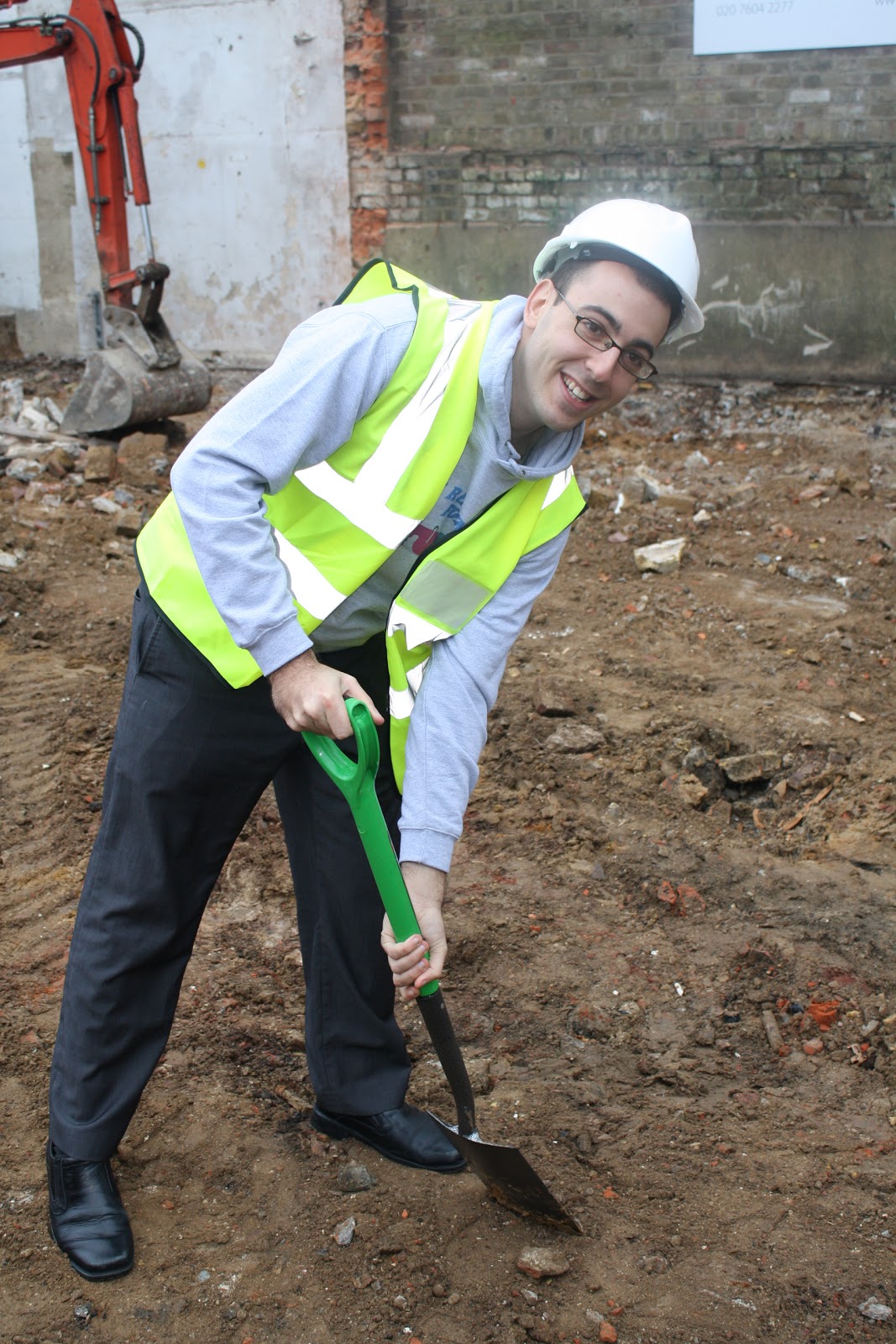
Youth Manager Laurence Field at Groundbreaking

Last Thursday, on a cold and blustery day, something special was happening at the LJCC. Our patrons, board members, volunteers and staff, as well as charity heads, journalists and the MP for Finchley and Golders Green, Mike Freer, all gathered for the groundbreaking ceremony of the Catherine Lewis Youth Centre.

This 2,500 sq.ft. Youth Wing will be built on the LJCC’s existing site at Golders Green and will house the activities of the Fusion youth programme. Fusion includes activities such as filmmaking, cartooning and cookery for 8-17 year olds and has been steadily outgrowing the capacity of the main building.

Speaking to LJCC Youth Manager Laurence Field about the significance of the Youth Wing, he explained that research has shown that there is a demand in the community for a secure youth space which is unaffiliated. The aim of the Youth Wing is to allow children to enjoy creative skill based activities without promoting any particular one kind of “Jewishness” above others. He also mentioned the importance of having a space which young people could “call home” and have “ownership” of: from having a lounge room to relax in to a screening room in which to show the films they have created.

MP Mike Freer placed his support behind the project and spoke of the importance of instilling confidence in younger members of society through creative activities. LJCC Chairman Michael Marx thanked all the funders who are making the building possible, including, among others, the Catherine Lewis Foundation, the Jewish Youth Fund and Natie Kirsh.   

“We’ve been talking about it for so long, it’s exciting to finally see it happening!” commented LJCC trustee and Kindertransport survivor Joanna Millan as the first clod of earth was being ceremonially turned.

With the aim of having the Youth Wing built and running within a year, this is going to be a very interesting time for youth provision in north London!

To see the latest Fusion activities, click here.